


Comparison At The 1,000 L/H Class, 5 Effects:
| Series | Output L/h | Feed water kg/h | Industrial steam kg/h | Cooling water L/h | H × L × W mm |
|---|---|---|---|---|---|
| S | 1,000 | 1,150 | 295 | 256 | 3,685 × 2,180 × 980 |
| F | 1,100 | 1,265 | 290 | 310 | 4,100 × 2,850 × 900 |
| B | 1,015 | 1,045 | 247 | 150 | 2,900 × 3,100 × 1,200 |
Worked sizing example:
| Step | Value |
|---|---|
| Available industrial steam | 7 bar |
| Pure steam pressure required | 2 bar |
| Peak pure steam demand | 500 kg/h |
| Conversion coefficient | 1.7 |
| Rated output required | 500 ÷ 1.7 = 294 kg/h |
| Model selected | PSG300 class |


Multi-effect water distiller
Which Multi-Effect Water Distiller to Choose?
- S Series— standard multi-effect, high purity WFI, general pharmaceutical use
- F Series— rising-film evaporation, 100% heat exchange, ~20% steam saving (energy-focused)
- B Series— highest WFI quality, easy to validate/maintain
- Vapor Compression (VC)— up to 92% feed-water utilization, >50% energy saving, no cooling water, not under ASME pressure-vessel rules (lowest running cost)

AIPAK Engineering GMP Standard S Series Multi-Effect Water Distiller
AIPAK Engineering multi-effect water distiller all the components and parts of the equipment are made of the 316L throughout. The distilled water generated from the water distiller is of high purity and without heat source, which is in full compliance with all the quality indicators of water for injection stipulated in the USP / Ph. Eur. This equipment proves to be an ideal choice for manufacturers of such pharmaceuticals as various blood products, injections, and infusion solutions, biological antimicrobial agents.
Stable quality and high purity
Reasonable structure, easy operation
High heating efficiency, low consumption

AIPAK Engineering Automatic F Series Multi-Effect Water Distiller with CE and ISO
AIPAK Engineering pharmaceutical F Series Multi-Effect Water Distiller is designed through scientific calculation, the quantity of heat is utilized many times circularly, so they have high thermal efficiency. Compared with old type, single-effect distilled water equipment, the multi-effect distilled water machines can save more than two thirds of energy. They are presently the pioneer and the best energy saving distilled water equipment in China.
Adopt rising film for evaporation to solve the problem of uneven distribution of water
High thermal efficiency, 100% heat exchange
Save industrial steam consumption, 20% energy saving

AIPAK Engineering B Series Multi-Effect Water Distiller For Pharmaceutical Plant
AIPAK Engineering B series multi-effect water distiller ensures the production of highly purified water, which is essential for the preparation of pharmaceutical ingredients and stringent quality control. Likewise, in the medical field, it plays a crucial role in supporting sterilization processes and maintaining hygiene standards. Laboratories extensively utilize this high-quality distilled water for research and experiments. Furthermore, it finds applications in the electronics manufacturing and chemical industries, where it is employed for tasks such as component cleaning and chemical reactions.
Highest WFI Quality
Easy to Validate
Easy to Maintain

AIPAK Engineering Vapor Compression Water Distiller
AIPAK Engineering vapor compression water distiller(VCS) is widely used for producing distilled water for injectable use or WFI, which is compliant with the requirements of the International pharmacopeias including USP, EP and JP. Water produced by this vapor compression water distiller has very superior quality than water produced by other multiple effect distiller. The feed water utilization is up to more than 92%. It operates below the pressure threshold that triggers pressure vessel certification. The comprehensive energy saving is up to more than 50% for each unit capacity comparing to multi-effect distiller and waste heat recovery module energy saving can be up to more than 70%.
Avoiding bacteria growth easy for cleaning and sterilization
Comply with FDA and EU GMP requirement
No cooling water consumption


The Buyer's Guide
Pharmaceutical Water System: Design, Equipment & GMP Compliance Guide
A pharmaceutical water system is not a utility. It is a GMP-critical process system: water is the highest-volume raw material in almost every dosage form, it is the only ingredient that is manufactured on site rather than purchased, and it is the system inspectors open first.
This guide is written for plant engineers, project managers and QA staff who are specifying, sizing or validating a water system — not for general readers. It covers what each water grade is, how the equipment is selected, which pharmacopoeial and GMP requirements apply, and what documentation should arrive with the equipment.
1. What is a pharmaceutical water system?
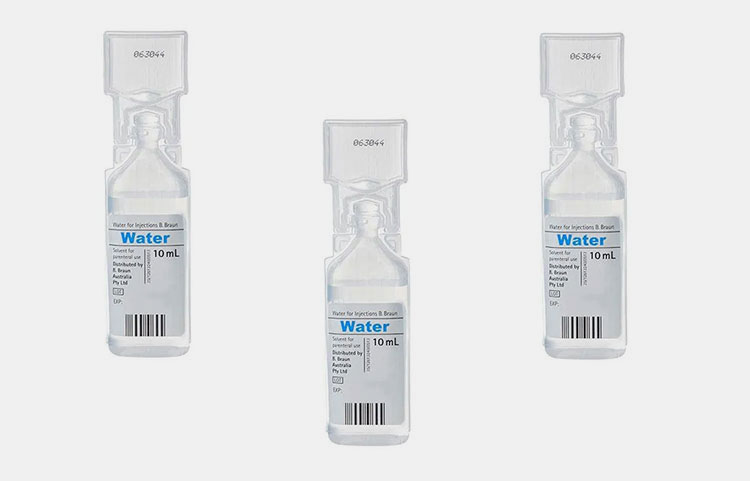
Pharmaceutical Water
A pharmaceutical water system is the integrated set of equipment that converts potable feed water into one or more compendial water grades and delivers them to points of use at a validated quality.
It has three functional blocks:
| Block | Function | Typical equipment |
| Pre-treatment | Protect downstream membranes and remove bulk contaminants | Multi-media filtration, activated carbon, softener, dosing skid, cartridge filtration |
| Generation | Produce the compendial grade | RO, RO+EDI, multi-effect water distiller, pure steam generator |
| Storage & distribution | Hold and circulate water without degrading it | Storage tank with vent filter, loop pump, heat exchanger, UV or ozone, sanitary loop piping |
The system is only as good as its weakest block. A correctly specified distiller feeding a loop with dead legs will still fail Performance Qualification.
2. What types of pharmaceutical water are there?
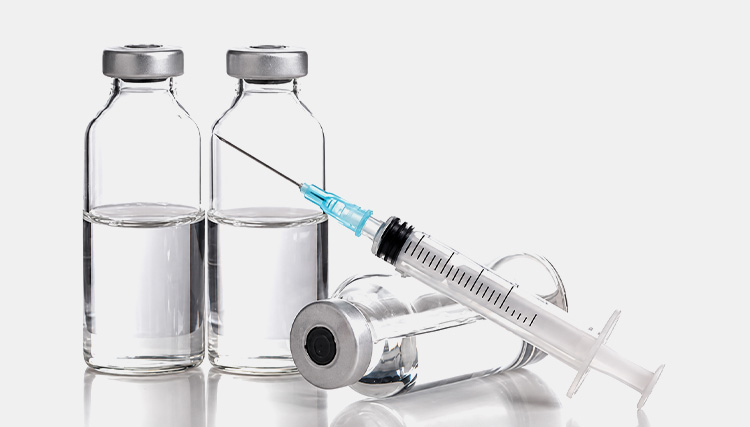
The grades
| Grade | Produced from | Primary use |
| Purified Water (PW) | Potable water | Excipient in non-parenteral products; equipment cleaning; feed to WFI and pure steam generation |
| Water for Injection (WFI) | PW or equivalent-quality feed | Excipient in parenterals; final rinse of product-contact surfaces |
| Pure Steam (Clean Steam) | PW or WFI | SIP of equipment and piping; sterilization of porous loads; humidification of classified areas |
| Water for Hemodialysis | Potable water | Dilution of haemodialysis concentrates |
| Sterile Purified Water | PW, sterilized and packaged | Analytical and non-parenteral preparation |
Four further grades — sterile water for injection, bacteriostatic water for injection, sterile water for irrigation and water for haemodialysis — are finished pharmaceutical products or point-of-care preparations, not outputs of a water system. They are produced from WFI by a downstream filling and sterilisation process, or prepared on site at the point of care. A water system project does not produce them; a filling line does.
→ Full comparison of all pharmacopoeial water grades
| Attribute | Purified Water | Water for Injection |
| Conductivity (USP, Stage 1) | ≤ 1.3 µS/cm @ 25 °C | ≤ 1.3 µS/cm @ 25 °C |
| Conductivity (Ph. Eur.) | ≤ 4.3 µS/cm @ 20 °C | ≤ 1.1 µS/cm @ 20 °C |
| Total Organic Carbon | ≤ 500 ppb | ≤ 500 ppb |
| Bacterial endotoxins | Not applicable | ≤ 0.25 EU/mL |
| Microbial count (action limit, guidance value) | 100 CFU/mL | 10 CFU/100 mL |
Microbial limits are action limits recommended in guidance, not compendial specifications — each site sets its own alert and action levels based on validation data and product risk.
3. How do you choose between PW, WFI and pure steam?
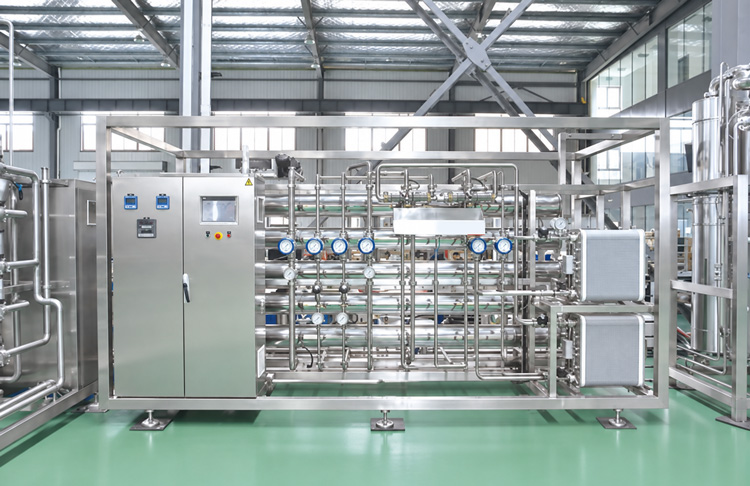
Most facilities need more than one grade. The decision is driven by dosage form, not by budget.
| If your plant makes… | You need | Typical configuration |
| Oral solids, oral liquids, topicals | PW only | RO + EDI, cold or hot loop |
| Non-sterile products with sterile-area cleaning | PW + limited pure steam | RO + EDI + small pure steam generator |
| Small volume parenterals (ampoules, vials) | PW + WFI + pure steam | RO + EDI → PW loop → multi-effect distiller → WFI loop; separate pure steam generator |
| Large volume parenterals (IV solutions) | PW + high-capacity WFI + pure steam | Same architecture, WFI capacity scaled to filling line throughput |
| Biologicals, lyophilized products | PW + WFI + pure steam, higher redundancy | Duplicated generation, hot WFI loop, full PAT instrumentation |
A useful rule: if any product is injected, irrigated or contacts a sterilized surface as a final rinse, WFI is required. If any equipment is steam-sterilized in place, pure steam is required — plant steam cannot substitute.
4. How is Water for Injection produced — distillation or membrane?
This is the single most consequential decision in a water system project, and it is often made by default rather than by analysis.
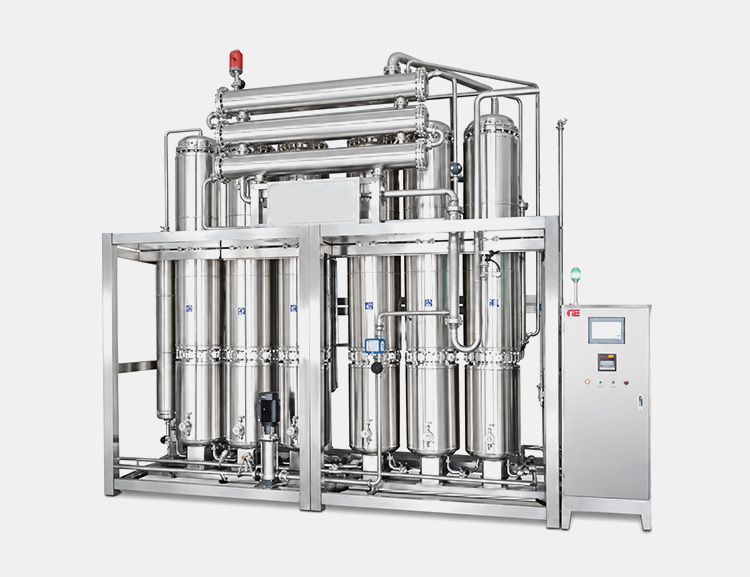
Distillation.
Multi-effect distillation is the traditional and universally accepted route. It uses phase change to separate water from dissolved solids, non-volatile organics, endotoxins and micro-organisms, and it produces WFI hot — typically above 80 °C — which is inherently self-sanitizing.
Membrane-based ("equivalent") processes.
The Ph. Eur. monograph for Water for Injections was revised to permit production by methods equivalent to distillation — typically reverse osmosis in combination with ultrafiltration or EDI, coupled with appropriate process analytical technology and enhanced monitoring. USP permits distillation or an equivalent or superior process.
How to choose in practice:
| Factor | Favours distillation | Favours membrane route |
| Regulatory conservatism of destination market | ✔ Strongly | |
| Plant steam already available in quantity | ✔ | |
| Steam unavailable or expensive; electricity cheap | ✔ | |
| Cold WFI required at point of use | ✔ | |
| Inspection by authorities unfamiliar with membrane WFI | ✔ | |
| Lowest microbiological risk with simplest justification | ✔ |
For most projects in markets aligning to PIC/S or EU GMP, multi-effect distillation remains the lower-risk specification — it needs no regulatory argument.
5. What equipment makes up a pharmaceutical water system?
5.1 Purified water generation (RO / RO+EDI)
Four configurations cover almost all requirements:
| Configuration | Description | Output quality |
| RO | Single-pass reverse osmosis; first-stage desalination | Suitable as pre-treatment; not a compendial PW route on its own in most feed conditions |
| RO + EDI | EDI replaces the conventional mixed-bed unit; no chemical regeneration | Feed resistivity requirement 0.025–0.5 MΩ·cm; product up to > 15 MΩ·cm |
| Hot-water-sanitizable PW system | Fully automatic backwash, regeneration, low-frequency circulation and sanitization sequences | Product-contact components and terminal piping in 316L; pre-treatment piping in SUS304; concentrate recovery |
| Two-pass RO + EDI | For poor feed quality or higher design margin | Conductivity ≤ 0.1 µS/cm · TOC ≤ 100 ppb · microbial ≤ 20 CFU/mL |
5.2 Multi-effect water distiller
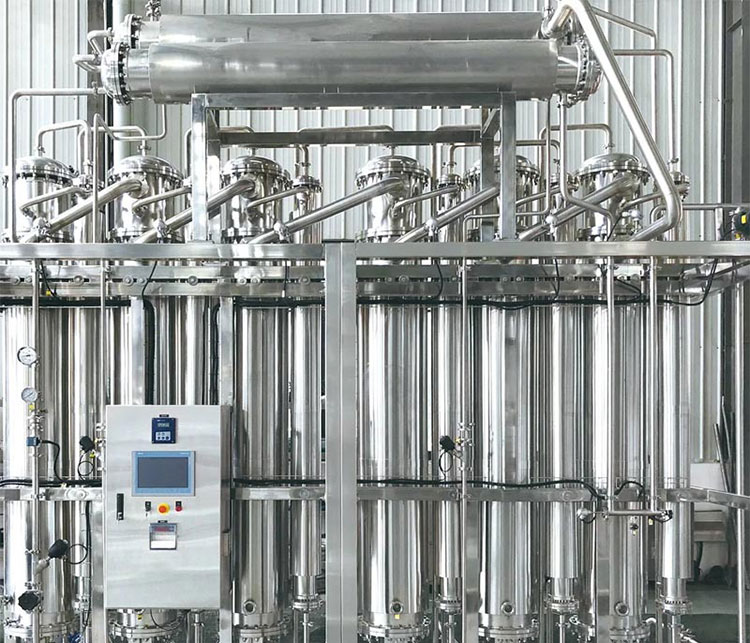
AIPAK ENGINEERING Multi-effect Water Distiller
Three evaporation designs are offered, all rated at industrial steam inlet 0.3 MPa and cooling water inlet 0.2 MPa.
| S series | F series | B series | |
| Evaporation principle | Falling film, multi-stage | Falling film with three-stage centrifugal separation | Rising film with multi-diversion separation |
| Control system | Standard | Siemens S7, bilingual EN/CN HMI | Standard |
| Notable features | 316L throughout, acid-washed and passivated; 0.6 µmRa mirror-polished tubing; automatic orbital welding | Inlet booster pump, dashpot and collection tank, plant steam reducing valve, continuous non-condensable gas venting, continuous residual discharge, WFI conductivity and valve position recording, full FAT | 100 % heat exchange, ~20 % industrial steam saving, precise feed-water distribution per effect, maintenance-free diversion device |
| Capacity range | 100–5,000 L/h | 110–5,500 L/h | 120–5,000 L/h |
| Number of effects | 4–6 | 4–6 | 4–6 |
How to read this table.
Steam consumption falls as the number of effects rises, and the B series reduces it further through rising-film evaporation — at the 5-effect 1,000 L/h class the saving against the S series is approximately 16 %, and at 6 effects approximately 17 %. Compare designs at equal effect count; a 6-effect unit will always beat a 4-effect unit regardless of series.
Full capacity tables for all three series (100–5,000 L/h, 4–6 effects) are available on request.
5.3 Pure steam generator
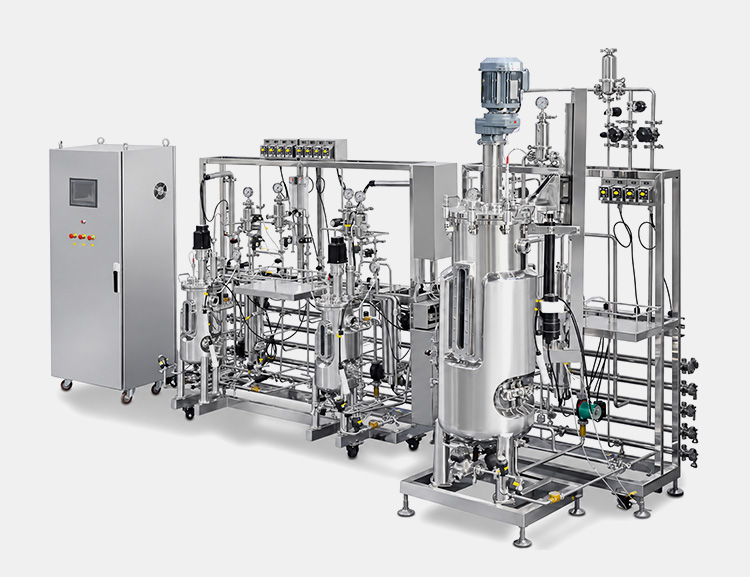
Capacity is quoted at a standard condition and must be converted to site conditions before selection.
Rating basis: pure steam at 3 bar, industrial steam at 6 bar.
Utility requirements:
- Industrial saturated steam, free of impurities and corrosive substances, maximum 9 bar
- Feed water: deionized, free of silica, chlorine, amines and volatile substances, 1–2 bar
- Compressed air: dry, oil-free, minimum 6 bar
- Power supply: to client specification
Capacity range PSG100 to PSG4000.
5.4 Storage and distribution
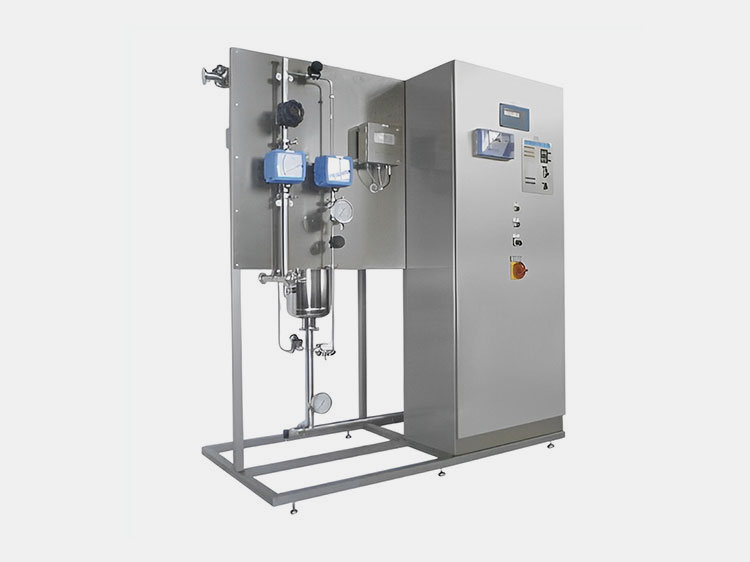
Water Distribution System
| Purified water loop | WFI loop | |
| Piping | 316L, dead-leg free, sanitary clamp connections | 316L, dead-leg free, sanitary clamp connections |
| Surface finish | Product-contact Ra < 0.6 µm | Product-contact Ra < 0.6 µm |
| Fittings standard | Sanitary | ASME BPE compliant |
| Temperature control | Per design | Fully automatic constant-temperature control, interlocked with the distiller |
| Valves | — | Imported control valves |
| Loop design | No intermediate buffer tank in the loop, to prevent microbial growth | Continuous circulation |
| Delivery | Pre-assembled and operationally qualified at the manufacturing plant | Pre-assembled and operationally qualified at the manufacturing plant; full validation documentation provided |
6. Hot or cold system — which should you choose?
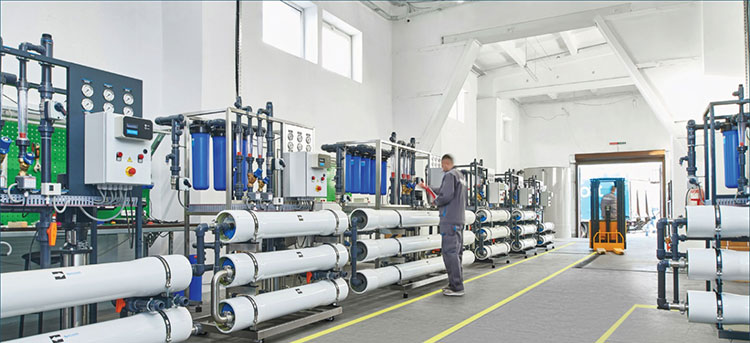
The distinction is a microbial control strategy, not a quality grade.
| Hot system | Cold system | |
| Control mechanism | Continuous circulation at ≥ 65 °C (commonly 70–80 °C) suppresses microbial proliferation | Ambient circulation with ozone or UV, plus periodic thermal or pure steam sanitization |
| Biofilm risk | Strongly suppressed — but not eliminated; dead-leg control, surface finish and periodic sanitization are still required and must be validated | Higher; depends on sanitization frequency and loop hydraulics |
| Energy | Higher — continuous heating plus heat exchange at points of use | Lower, but not zero: circulation pumps, ozone generation or UV, and periodic heat-up cycles all consume energy |
| Heat-sensitive processes | Point-of-use cooling required | Water available at ambient temperature directly |
| Regulatory argument | Simplest to justify | Requires robust sanitization and monitoring rationale |
Practical guidance: hot WFI loops are the default for parenteral facilities in PIC/S-aligned markets. Cold or ambient PW loops with ozone are common and well accepted for oral solid and liquid facilities where point-of-use temperature matters and energy cost is significant.
7. How do you size a pharmaceutical water system?
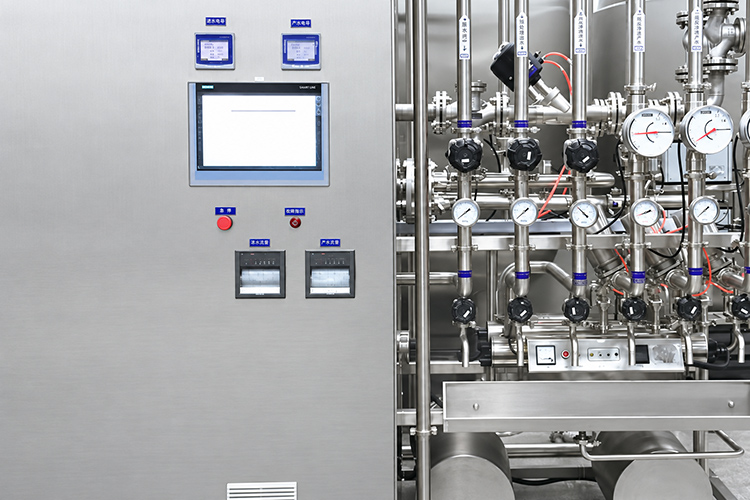
AIPAK ENGINEERING's Pharmaceutical Purified Water Treatment System
Sizing from "how many litres per day do we use" produces undersized systems. Size from the peak.
Step 1 — Build a point-of-use demand profile.
List every consumer: vessel charging, CIP cycles, final rinses, laboratory, humidification. Record the instantaneous flow and duration of each, not the daily total.
Step 2 — Identify simultaneous peak demand.
The governing case is usually a CIP cycle coinciding with a batch charge. Generation capacity is sized to peak, or storage is sized to buffer it.
Step 3 — Size storage against generation.
A larger tank allows a smaller distiller, at the cost of longer residence time and a greater microbial control burden. Typical practice is to size the tank to cover the largest single draw-off plus a safety margin, with the generator refilling within the inter-batch window.
Step 4 — Set loop hydraulics.
Distribution loops are designed for turbulent flow — commonly specified as a minimum return velocity around 1 m/s — to limit biofilm establishment and ensure sanitizing agents reach all surfaces. Confirm the velocity requirement against the applicable design guide for the project.
Step 5 — Control dead legs.
The unused branch length should not exceed a small multiple of the branch diameter; the commonly applied rule is L/D ≤ 3, measured from the inner wall of the main. Zero-dead-leg valves at points of use are the standard solution.
Step 6 — Add margin for growth.
Water systems are among the hardest utilities to expand after qualification. Specify against the plant's five-year capacity plan, not its opening throughput.
8. What regulatory standards apply to a pharmaceutical water system?
| Standard | Scope |
| USP <643> | Total organic carbon |
| USP <645> | Water conductivity |
| USP <1231> | Water for pharmaceutical purposes — the principal design and control guidance |
| Ph. Eur. monograph 0008 | Purified Water |
| Ph. Eur. monograph 0169 | Water for Injections |
| EU GMP Annex 1 | Manufacture of sterile medicinal products — water system requirements for sterile facilities |
| WHO TRS, GMP for water for pharmaceutical use | The reference framework for WHO-PQ and many national GMP regimes |
| ASME BPE | Bioprocessing equipment — materials, surface finish, fittings, weld quality |
| ISPE Baseline Guide, Water and Steam Systems | Design practice |
| EN 285 | Pure steam quality criteria (non-condensable gases, superheat, dryness) |
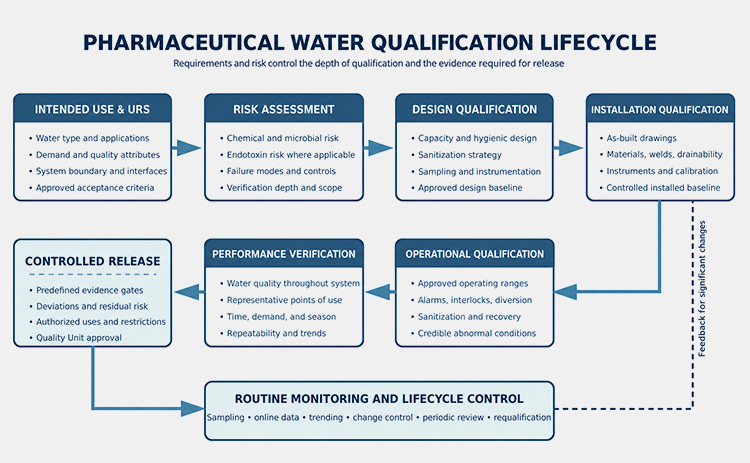
For projects targeting PIC/S or EU-GMP alignment, the water system is normally the first system inspected and the first to generate observations. Specifying to these standards at the URS stage is substantially cheaper than remediating after qualification.
9. What validation documentation comes with the system?
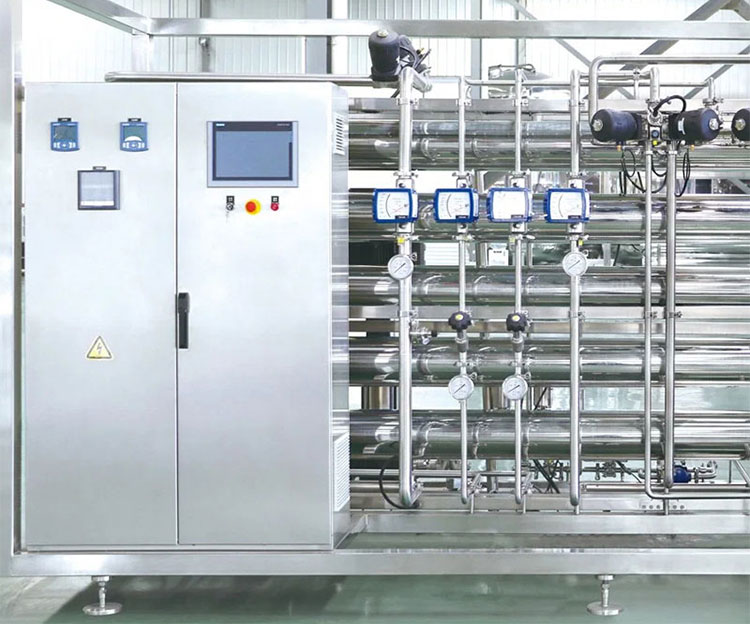
AIPAK ENGINEERING Pharmaceutical Purified Water Treatment System
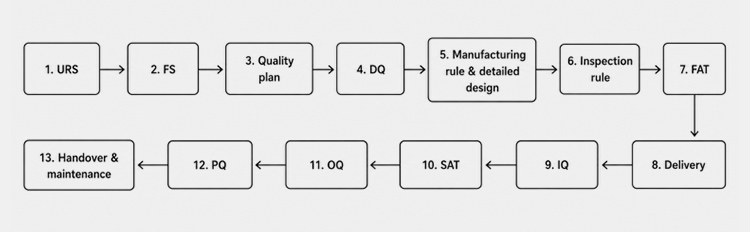
For a technical buyer this is often the deciding factor between suppliers at similar price and capacity. A complete package includes:
Design and engineering
- Response to the client's URS
- Functional Specification (FS)
- Quality plan and validation master plan
- Design Qualification (DQ)
- P&ID, general arrangement drawings, loop drawings
Manufacturing evidence
- 316L material certificates
- Surface roughness (Ra) test reports
- Boroscope inspection reports for orbital welds
- Weld logs and coupon records
- X-ray inspection reports where applicable
Testing and qualification
- Factory Acceptance Test (FAT) protocol and report
- Site Acceptance Test (SAT) protocol and report
- Installation Qualification (IQ)
- Instrument calibration certificates
- Operational Qualification (OQ)
- Performance Qualification (PQ)
- Computer system validation
- Standard Operating Procedures and operator training
On Performance Qualification.
PQ for a water system is conventionally run in three phases: an initial intensive sampling phase, a second confirmation phase, and a full one-year phase covering seasonal variation in the feed water. Phases one and two are typically two to four weeks each. Only after the first two phases is the system normally released for production use, with the one-year phase running concurrently.
Project execution sequence:
10. What quality control tests are required?
| Test | What it detects | Applies to |
| Conductivity | Ionic contamination | PW, WFI — in-line and laboratory |
| Total Organic Carbon (TOC) | Organic contamination from feed, resins, piping | PW, WFI |
| Bacterial Endotoxin Test (BET) | Pyrogenic lipopolysaccharide | WFI, pure steam condensate |
| Microbial enumeration | Aerobic bacterial and fungal count | PW, WFI |
| Sterility test | Absence of viable micro-organisms | Packaged sterile grades only |
| Particulate matter | Undissolved mobile particles | Packaged injectable grades |
| pH | Acid–base balance | Where specified by monograph |
| Antimicrobial effectiveness | Preservative efficacy | Bacteriostatic packaged grades only |
| Pure steam quality | Non-condensable gases, dryness, superheat | Pure steam, per EN 285 |
On endotoxin testing.
The traditional method uses Limulus Amoebocyte Lysate reagent. Recombinant Factor C (rFC) is an animal-free alternative that has been adopted into the compendia; where it is acceptable to the destination regulator it removes the supply-chain dependency on horseshoe crab lysate.
Sampling frequency and location are set in the PQ protocol and carried into routine monitoring. Every point of use is sampled during PQ; routine monitoring uses a rotating subset plus fixed critical points.
11. What are the common design pitfalls?
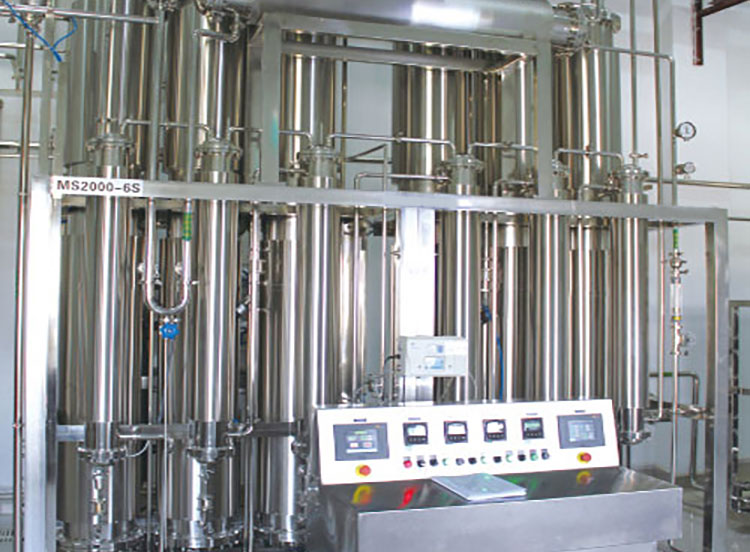
Production Volume and AIPAK Multi-effect Water Distiller
Dead legs.
The most frequent source of PQ failure. Every instrument tee, spare branch and drop leg is a candidate. Design them out; do not plan to sanitize around them.
Sample valve design.
Sample points that cannot be sanitized generate false positives and consume months of investigation time.
Rouging.
Iron oxide film formation on 316L in hot WFI systems. Controlled by correct passivation at fabrication, appropriate surface finish, and avoidance of chloride exposure during construction and hydrotesting.
Feed water seasonality.
Systems commissioned in one season fail in another. This is precisely why PQ Phase 3 runs for a full year.
Undersized storage.
Leads to generator short-cycling and unstable quality at the point of use.
Buffer tanks inside the loop.
Any stagnant volume in a circulating loop is a microbial reservoir. The loop should return directly to the main storage tank.
Construction-phase contamination.
Piping stored uncapped on site, welds made without purge gas, and hydrotesting with untreated water cause failures that only appear at PQ, when they are most expensive to fix.
Conclusion
A pharmaceutical water system is specified once and lived with for twenty years. The variables that matter are settled at the URS stage: which grades, which production route for WFI, hot or cold, what peak capacity, and which documentation package.Send us your URS or your point-of-use demand profile and we will return a system proposal with configuration, capacity, utility loads, layout and the full validation document list.
CONTACT US
Send us your raw water analysis or your point-of-use demand profile, and we will return a system configuration, utility loads, layout footprint and the full validation document list.
WhatsApp:+86 181 6426 8586
 Send it and an engineer will reply — not a sales template.