
Ampoule Filling and Sealing Machine Solutions: A Guide to 600 VPM High-Speed Production
Are you struggling to keep up with the high demand for injectable medicines in your pharmaceutical plant? Slow production lines can cause you to miss deadlines and lose profit. You need a solution that boosts speed without losing quality.
High-speed ampoule filling and sealing machines are integrated systems that wash, sterilize, fill, and seal glass ampoules at rates up to 600 vessels per minute (VPM). These lines use ultrasonic cleaning and laminar flow tunnels to ensure sterility, making them essential for large-scale pharmaceutical manufacturing.
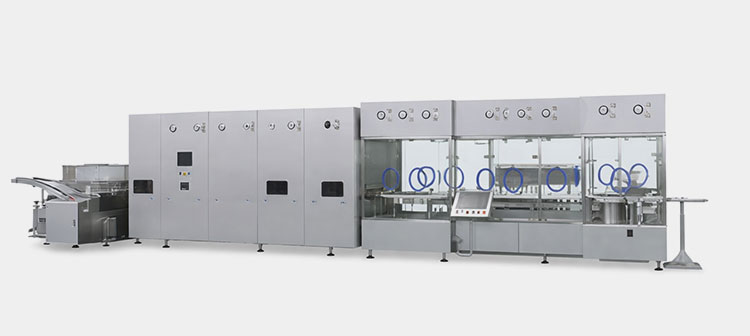
High speed ampoule filling line overview
If you stop reading now, you might miss the chance to double your factory's output. I am going to explain exactly how these machines work and how they fit into a modern production line. This guide will help you make the right choice for your business.
1.Why Is There a High Demand for High-Speed Aseptic Packaging?
Do you feel the pressure from the market to produce vaccines and antibiotics faster than ever before? If your current equipment is old, you risk contamination and slow delivery. The market will not wait for you to catch up.
The demand for high-speed aseptic packaging is driven by the global need for safe, injectable drugs produced in mass quantities. Manufacturers must move from manual or semi-auto processes to fully automated lines that handle 36,000 ampoules per hour to stay competitive.
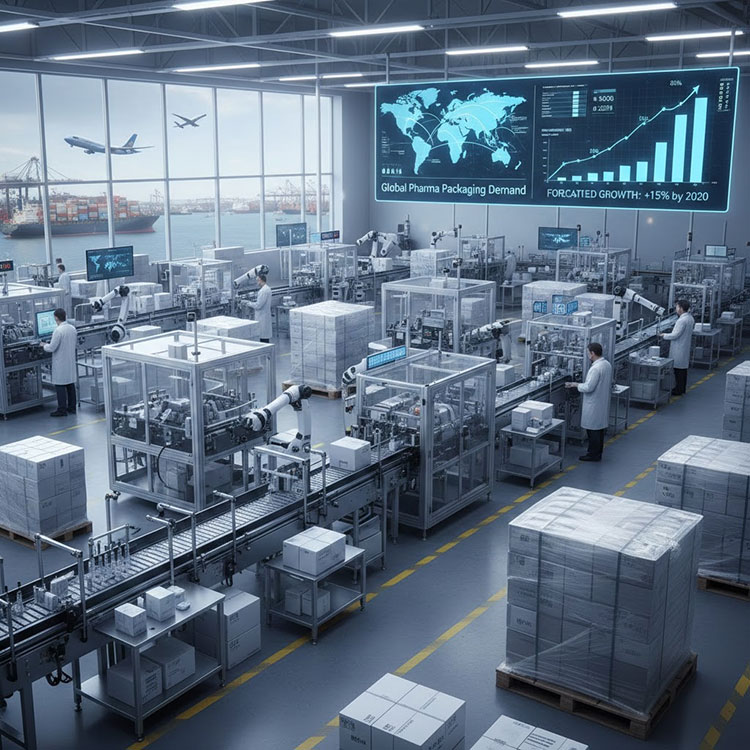
Global demand for pharmaceutical packaging
I have seen many factories struggle with this transition. In the past, a speed of 100 or 200 ampoules per minute was enough. But today, the standard for big pharma companies is 600 VPM. This shift is not just about speed. It is about safety and consistency. When you produce millions of doses, even a small error rate is a big problem.
We need to look at the factors driving this change. The pharmaceutical industry is growing. People need more vaccines, insulin, and antibiotics. These products must be sterile. A human operator cannot move fast enough to fill these orders. Also, humans carry bacteria. The less human contact, the better.
Automated high-speed lines solve these problems. They provide a closed environment. This protects the medicine from the outside world. At AIPAK ENGINEERING, we see clients who upgrade to these lines. They see an immediate drop in production costs per unit. They also pass GMP audits more easily.
Here is a breakdown of why speed matters in the current market:
| Feature | Old Standard (Low Speed) | New Standard (High Speed) |
| Output | 100-200 VPM | 600 VPM (36,000/hour) |
| Labor Cost | High (needs many operators) | Low (fully automated) |
| Contamination Risk | Moderate (more manual handling) | Very Low (integrated linkage) |
| Space Efficiency | Low (requires multiple slow lines) | High (one line does the work of three) |
By understanding this demand, you can see why investing in high-speed technology is not a luxury. It is a necessity for survival in the B2B pharma sector.
2.What Is the Anatomy of an Integrated Ampoule Water Injection Line?
Is your maintenance team confused by the complexity of modern linkage lines? If you do not understand how the parts connect, you will face long downtimes. You need to know the anatomy of the machine to run it well.
An integrated ampoule line consists of three main linked units: a vertical ultrasonic washing machine, a hot air circulation sterilization tunnel, and the filling and sealing machine. These units work together seamlessly to turn dirty glass into a finished, sterile product.
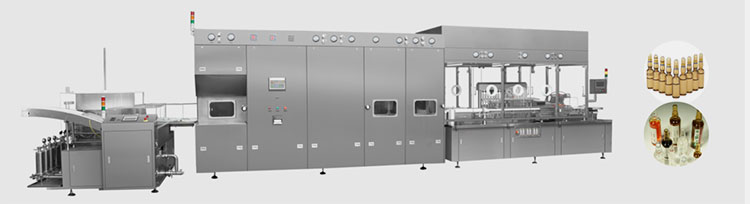
Diagram of washing sterilizing and filling sections
Let me break this down for you based on my experience at AIPAK ENGINEERING. The machine is not just one big box. It is a system. It works like a relay race.
First, we have the **Vertical Ultrasonic Washing Machine**. This is the start. The ampoules enter the machine. We use ultrasonic waves here. The waves create tiny bubbles in the water. When these bubbles burst, they scrub the dirt off the glass walls. It is very powerful. We also use a "three water, three gas" method. This means we rinse the bottle inside and outside multiple times with water and compressed air. This guarantees the glass is clean.
Next is the **Hot Air Circulation Sterilization Tunnel**. The wet, clean bottles go here. This tunnel is very hot. It reaches temperatures up to 350°C. The heat kills all bacteria and pyrogens. We use laminar flow technology here. This means the hot air flows in smooth, even layers. This prevents dust from moving around. It is vital for aseptic processing.
Finally, the bottles reach the **Filling and Sealing Machine**. This is the heart of the operation. The machine uses a step-by-step transmission system. It fills the ampoule with liquid nitrogen (optional) and medicine. Then, it uses a wire drawing method or flame to seal the glass tip. The 600 VPM speed happens here. The synchronization between the tunnel and the filler must be perfect. If the tunnel is too slow, the filler waits. If the filler is too slow, the bottles back up. Our systems at AIPAK are designed to balance this flow automatically.
Here is how the sections connect:
Infeed:Bottles are loaded onto the belt.
Washing:Ultrasonic cleaning + WFI (Water for Injection) rinsing.
Drying/Sterilizing:Pre-heating -> Sterilizing -> Cooling.
Filling: Nitrogen gas (pre) -> Liquid Filling -> Nitrogen gas (post).
Sealing:Pre-heating the glass neck -> Wire drawing seal.
Outfeed:Finished bottles go to the tray.
Understanding this flow helps you troubleshoot. If the seal is bad, you look at the last section. If the bottle is wet, you check the tunnel.
3.What Are the Key Technical Specifications You Must Check?
Are you worried about buying a machine that does not fit your factory's power or air supply? Buying the wrong specifications is a costly mistake. You must verify the technical data before you sign the contract.
Key technical specifications for a 600 VPM line include a filling range of 1ml to 20ml, a breakage rate of less than 0.1%, and a power requirement usually around 380V/50Hz. You also need to check the consumption of water, gas, and compressed air.
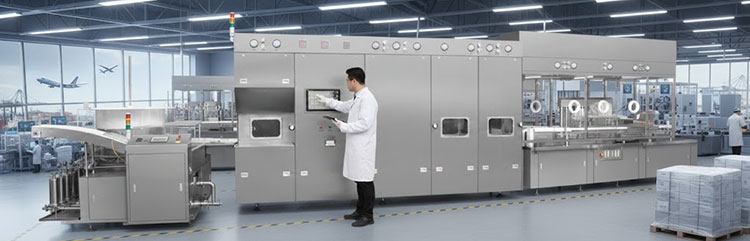
Engineer checking machine specifications
I always tell our clients to look beyond just the speed. Yes, 600 VPM is impressive. But does it handle your specific bottle size? Most high-speed lines handle 1ml, 2ml, 5ml, 10ml, and 20ml ampoules. However, changing parts between sizes takes time. You need to ask how long the changeover takes.
Let's look at the **Filling Precision**. This is critical. For a 1ml or 2ml dose, the error margin must be very small. Our machines usually offer a precision of ±1%. This saves you money. If you overfill every bottle by 2%, you lose a lot of expensive liquid over a year.
Another spec is the **Breakage Rate**. Glass breaks. It happens. But on a high-speed line, broken glass is a disaster. It can jam the machine. A good machine has a breakage rate lower than 0.1%. This means fewer stops and less waste.
You also need to consider utility consumption. These machines are big. They use a lot of power for the heating tunnel. You need to ensure your facility has enough electrical capacity. The washing machine also uses a lot of Water for Injection (WFI). You must have a water system that can keep up with the demand.
Here is a typical specification table for a high-speed line:
| Parameter | Specification |
| Production Capacity | 1ml-2ml: 30,000-36,000/hour (600 VPM) |
| Applicable Bottle | 1ml - 20ml Glass Ampoule (ISO standard) |
| Filling Accuracy | ±1% to ±2% (depending on volume) |
| Power Supply | 380V, 50Hz, 3-Phase (customizable) |
| Gas Consumption | LPG or Natural Gas for sealing |
| Cleanliness Class | Class A (Laminar Flow protection) |
When we design these at AIPAK ENGINEERING, we also look at the dimensions. A 600 VPM line is long. It might be 10 to 12 meters long. You must measure your cleanroom carefully. We can often curve the line into a "U" shape or "L" shape to fit your room.
4.How Do We Ensure Compliance and Operational Excellence?
Does the thought of a failed GMP audit keep you awake at night? If your machine does not meet the standards, your production will be shut down. You need equipment that is built for compliance from the ground up.
Operational excellence relies on machines that feature Clean-in-Place (CIP) systems, Sterilization-in-Place (SIP) capabilities, and full electronic data recording. This ensures you meet FDA and EU GMP standards while keeping the line running smoothly.
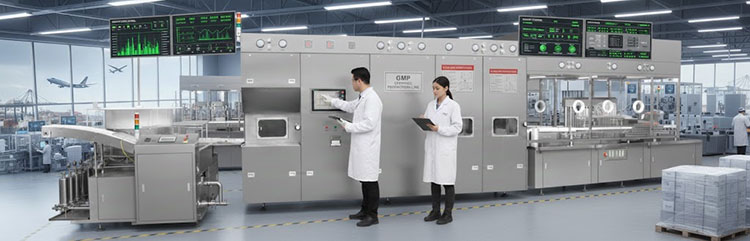
Quality control and GMP validation
I know that compliance is the most boring part of the job for some people. But for us manufacturers, it is the most important. The machine must be easy to clean. We use 316L stainless steel for all parts that touch the liquid. This material does not rust or react with the drug. It is easy to sanitize.
The control system is also part of compliance. In the past, operators wrote numbers in a notebook. Now, the machine does it. Our PLC (Programmable Logic Controller) screens record everything. They record the temperature of the tunnel, the speed of the belt, and the filling volume. If a batch is bad, you can look at the data. You can see exactly what went wrong. This is called "Traceability."
Operational excellence also means safety for the worker. The machine should have guards. If a door opens, the machine stops. The noise level should be low. High-speed glass handling can be loud. We use sound-dampening covers to protect your staff's hearing.
Maintenance is the final piece of this puzzle. A 600 VPM machine moves fast. Parts wear out. We design our machines with "modular" parts. This means you can swap out a broken part quickly. You do not have to take the whole machine apart. We also provide a list of spare parts you should keep on the shelf.
At AIPAK, we support you with the "Validation" process. This includes DQ (Design Qualification), IQ (Installation Qualification), OQ (Operational Qualification), and PQ (Performance Qualification). We give you the documents you need to show the inspector.
5.Why Choose AIPAK Engineering for Your Production Line?
Are you tired of suppliers who sell you a machine and then disappear? It is frustrating when you cannot get support. You need a partner who stays with you for the long term.
AIPAK Engineering offers 15+ years of experience in pharmaceutical processing, providing customized 600 VPM solutions and 24/7 global support. We do not just sell machines; we help you build a complete, successful production capability.
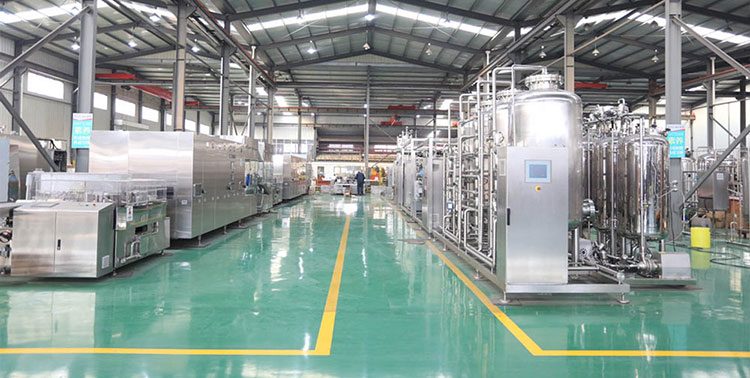
AIPAK ENGINEERING factory floor and engineers
I want to share why our clients trust us. We are based in Wuhan, China, but we serve the world. We have worked with factories in the USA, Europe, and Asia. We understand that every factory is different. Maybe you have a small room. Maybe you have a special type of liquid that is very thick. We customize the machine for you.
We are a manufacturer, not a retail shop. We focus on B2B. This means we understand the language of business. We know you need ROI (Return on Investment). We build our machines to last. We test every machine before it leaves our factory. You can come to visit us, or we can do a video call to show you the test run.
Our team is our strength. We have engineers who have been doing this for decades. When you call us, you talk to experts. If you have a problem at 2 AM, our online support is there. We can also send engineers to your site to install the machine and train your staff.
We cover the whole process. We do not just do ampoules. We do tablet presses, capsule fillers, and packaging. If you want to expand your business later, we can help you with that too. We are a one-stop solution for solid and liquid pharma processing.
Choosing AIPAK ENGINEERING means choosing reliability. We have the history and the growth to prove it. We want to be your partner, not just your vendor.
Conclusion
To summarize, achieving 600 VPM production requires an integrated washing, sterilizing, and filling line that meets strict GMP standards. By choosing the right specifications and a partner like AIPAK ENGINEERING, you ensure safety, efficiency, and profit.
Don't forget to share this post!
CONTACT US
Tell us your raw material and project budget to get quotations within 24 hours.
WhatsApp Us: +86 181 6426 8586
 Tell us your material or budget, we'll reply you ASAP within 24 hours